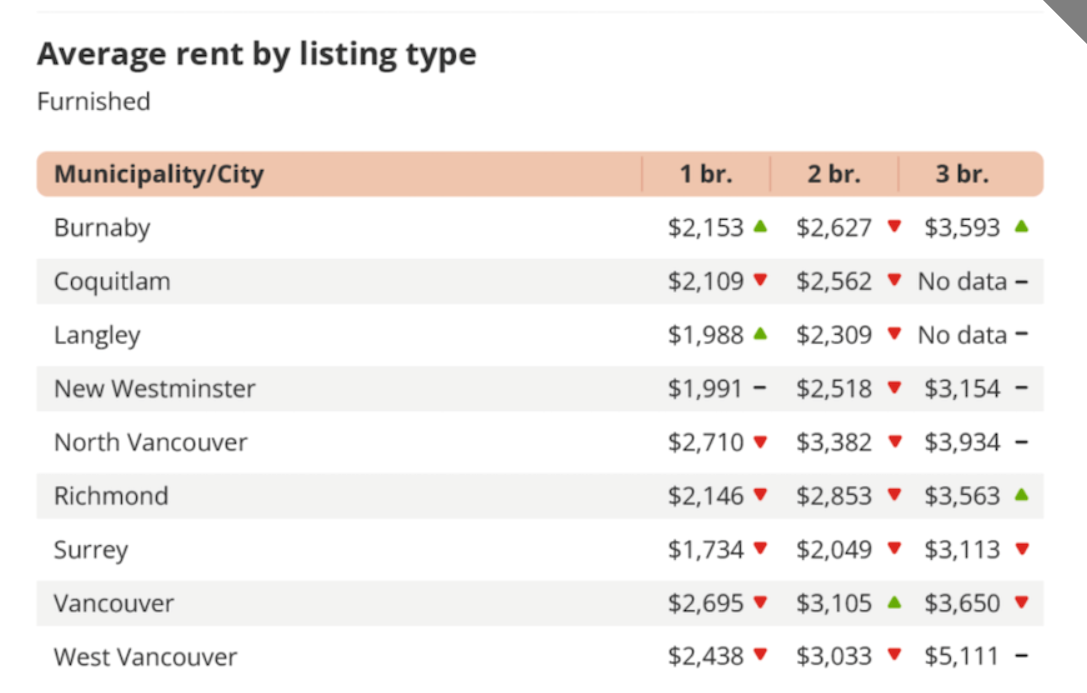
Metro Vancouver continues to hold its position as the most expensive rental market in Canada, even as regional prices show a modest decline. The area remains consistently at the top of the national rental hierarchy, reflecting ongoing demand pressures and limited housing supply across the Lower Mainland. According to the latest data, the country’s five priciest cities for renting a one-bedroom apartment are all located within this region, underscoring how Vancouver and its surrounding municipalities continue to dominate Canada’s rental landscape.
The most recent rent report from liv.rent indicates that the average price for a newly listed, unfurnished one-bedroom unit in Metro Vancouver fell slightly from $2,223 in October to $2,164 in November, representing a month-over-month decrease of $59. While this small drop may offer some relief to renters, it remains marginal relative to the overall high cost of living in the city. Despite the decline, Metro Vancouver’s rental rates are still far above the national average, highlighting the persistent affordability challenges facing residents in the region.
Year-over-year data further illustrate the long-term trends affecting the rental market. Compared with November 2024, the average rate for an unfurnished one-bedroom unit has decreased by $195. This decline signals some easing in rental pressures, likely influenced by broader market trends such as new housing developments, seasonal fluctuations, and shifts in tenant demand. Nevertheless, even with this reduction, Metro Vancouver continues to be significantly more expensive than other Canadian urban centers, keeping the region at the forefront of the country’s rental cost rankings.
The concentration of high rental prices in the Lower Mainland is partly due to the region’s sustained population growth, coupled with limited land availability for new developments. Cities such as Vancouver, Burnaby, Richmond, Surrey, and North Vancouver consistently appear among the most expensive in Canada for one-bedroom units. This clustering of high-cost areas reflects both the desirability of the region—driven by employment opportunities, amenities, and quality of life—and structural constraints in the housing market, including zoning limitations and construction costs.
While the month-over-month decline may offer some short-term relief for prospective tenants, affordability challenges remain a critical concern. Many renters are still paying rates that consume a disproportionate share of their income, prompting ongoing discussions about housing policy, rent regulation, and strategies to increase the supply of affordable units. Analysts suggest that even modest decreases in rental rates may not significantly improve accessibility for many residents, particularly in highly sought-after neighborhoods with limited vacancy.
In summary, Metro Vancouver continues to be Canada’s most expensive rental market despite a slight decrease in prices over recent months. While the average rate for a newly listed, unfurnished one-bedroom apartment has fallen to $2,164 in November, down from $2,223 in October and $195 lower than November 2024, the region remains unaffordable for a large segment of the population. The enduring combination of high demand, limited housing supply, and strong desirability ensures that the Lower Mainland retains its position at the top of the country’s rental cost rankings, keeping affordability challenges front and center for policymakers, developers, and residents alike.